Wins, upcoming talks, and what I'm building right now.
Co-presenting The Fractionals Live, Amsterdam On stage with Dorothy Seguy, to a room of senior fractional operators (CMOs, CTOs, CPOs, founders), on human-led growth and AI-assisted execution. I'll show how AI agents and workflow design help you scale outreach and follow-up, prioritize the right conversations, and cut the manual work, without automating the human side away.24 Jun 2026
Not a chatbot, an operator. A personal AI operating system that plans, decides, and executes the real work across everything I do. It runs inside Conductor on Claude Code and remembers across sessions, so its reasoning compounds instead of starting from zero. It breaks work into small, self-contained packages — each one opens its own session on its own branch, does a single job, and closes against a written definition of done. And each job goes to the right model: a frontier model to orchestrate, smaller ones to synthesize and search, a local one for the cheap work.
It holds itself to the kind of engineering discipline you'd expect from a team, not a side project: a handful of firm principles, backed by checks that actually run. Nothing ships unless the code compiles, the tests pass, the internal layers stay separate, and no private data can leak into anything public. It even learns — my corrections get turned into permanent improvements, with my sign-off before any of it sticks.
I build the whole thing in the open, including the part most people hide: the first version failed, and I document exactly why. Every decision is recorded with its reasoning, so nothing gets re-litigated and the learning compounds. And the parts that prove themselves I release as free skills, prompts, and patterns you can drop straight into your own setup.
New builds, posts, and free skills as they land. No spam, unsubscribe anytime.
Spinning out into products
The parts that prove themselves become products you can plug straight into your own setup. First up:
Agent dashboard
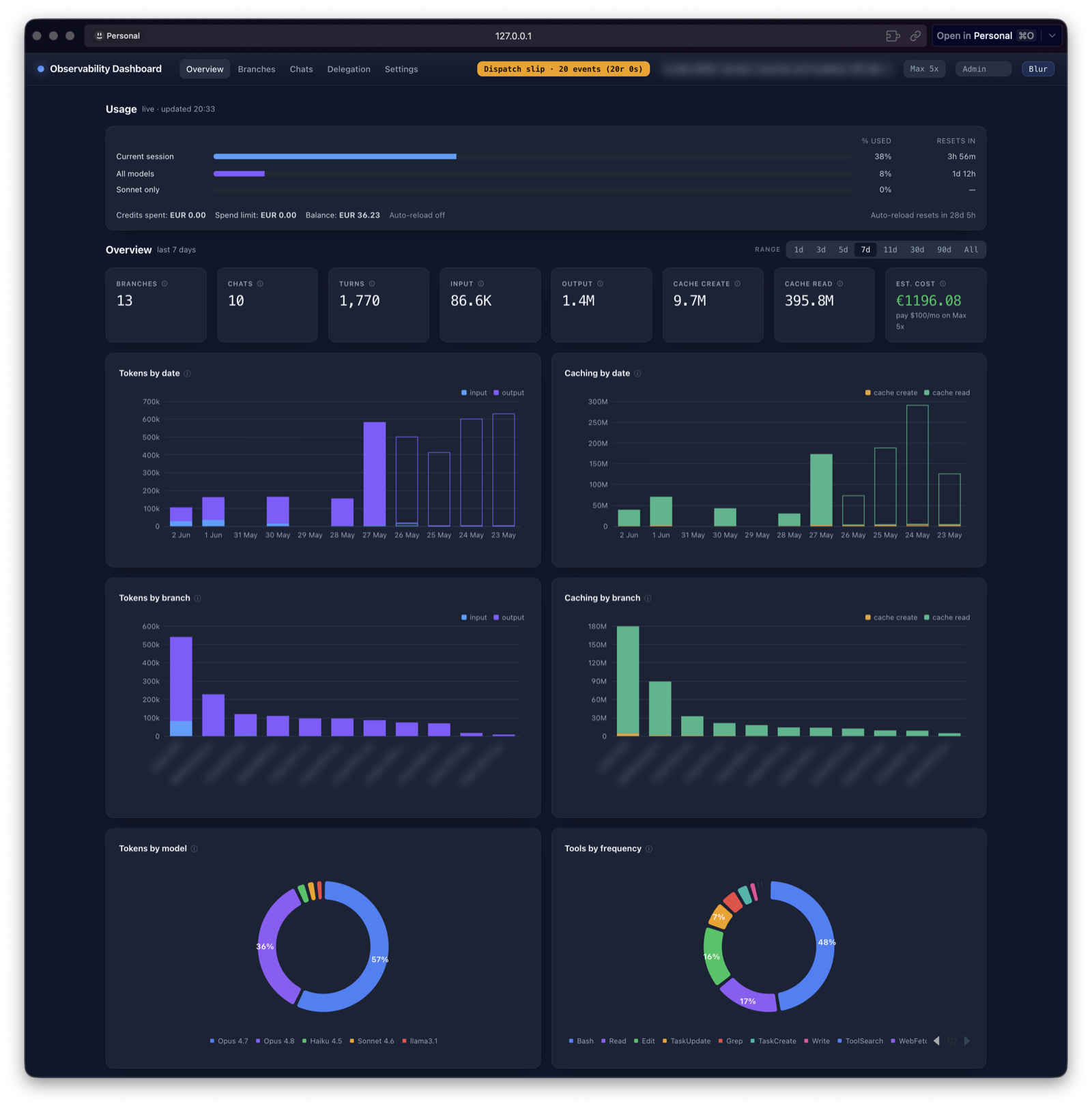
See what your AI agents are doing, what they cost, and where the money goes — live, across Claude Code, Codex, and local models. It shows how much each one reuses instead of paying for twice, how close you are to your limits, and a short write-up of every session. It runs on your own machine. Nothing leaves it, and there's no service to sign up for.
Paid · coming soon
Work with me
If you want to learn the new way of working — and you actually want it to stick
I work with operators who are serious about AI and don't want a black box. Founders running their own company. Fractionals running other people's. We pick a concrete workflow. I set you up with your own AI operating system and the thinking behind it. Then I build alongside you until the new way of executing the workflow sticks. Done with you, not done for you.
Hourly or project-basedHourly from €175 · projects priced to scope · startup- and solo-operator friendly
A single AI system you direct, instead of a pile of disconnected apps and chatbots. It's connected to your tools and data, keeps context across your work, and calls its own skills and sub-agents to actually get things done. You manage one agent, and it runs the real work: meetings, research, writing, outreach. I'm building mine in public, and teaching others to build their own.
I build AI operating systems. A connected layer that runs a business's real work. I help operators make that way of working stick, so it spreads through their team, or the teams they run. Right now I'm building an AI operating system from scratch, in public.
With you. I set you up with your own AI operating system and the design principles behind it, then help you build your operation one step at a time. Done-with-you, not done-for-you — so you're never dependent on me.
No. I spent 20 years running operations, not writing code. The point is to give you the understanding and the tools to build, at whatever level you're starting from — from simple automation to more complex sub-agents.
No — and I'll tell you when it doesn't. Plenty of bottlenecks are solved better by a simple automation or a process change. I help you find the real bottleneck first, then decide whether AI is the right answer for it.
Tell me what you're building. A short message about where you're stuck is enough to figure out whether and how I can help.
This site uses one essential cookie for sign-in and privacy-friendly, cookieless analytics. Privacy & cookies.